
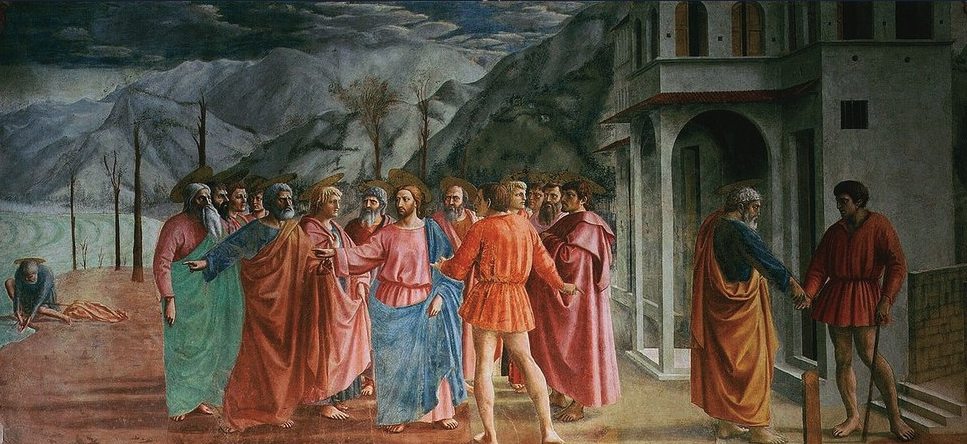
The Tribute Money by Masaccio, 1427
Before we. dive into the weekly reading, let’s look closely for a minute at the featured artwork, a breakout piece of genius in composition, perspective, texture, and narrative. This early renaissance fresco was way ahead of its time in 1490, three generations before the masterpieces in Rome were commissioned. In the center we see the temple tax being demanded, and Jesus telling Peter to go get a fish. To the left we see Peter retrieving the money from the fish’s mouth, and then to the right we see the tax being paid to the collector. A word I just learned today is Chiaroscuro, an artistic technique that uses strong, deliberate contrasts between light and dark to create three-dimensional volume, depth, and dramatic mood on a flat surface. This painting was years ahead of its time in that, too.
This week’s reading we see giant crowds following Jesus, soaking up his teaching and marveling in the miracles. We also see more people rejecting the message, refusing to host Jesus and the disciples, and arguing with him, although they do not deny his wisdom and mastery of scripture. His challenging prophesy and cultural criticism are hard to accept, but he really crosses the line when, in a heated debate with religious leaders, he makes the most inflammatory public claim to date. “Before Abraham was, I AM.” This was a flashback to the book of Exodus, when Moses asked for God's name and God answered, “Ehyeh Asher Ehyeh,” which is translated as "I Am Who I Am." When Jesus says these words in the synagogue, everyone in the crowd knows that he is claiming to be deity. As they pick up stones in order to kill him, Jesus is suddenly hidden from them. His time hasn’t come, but he’s not mincing words about it with his disciples. He plainly tells those closest to him that he will be killed, and will ascend into heaven. “Where I am going you cannot come,” he says.
The word Jesus used that stirred their anger was Ehyey, from Exodus 3:14 “Ehyeh Asher Ehyeh” ("I Am Who I Am"). It carried a deep meaning from the original language and tense, and over the centuries that meaning deepened further, until Jesus used it precisely according to plan. That plan, and the deepening meaning of it, calls to mind a certain Greek word: logos.
Logos, the word used at the beginning of John’s gospel to describe Jesus, was used heavily by Greek philosophers, including Plato and Aristotle, to mean word, reason, or plan. Around the time of Jesus, Jews throughout the Mediterranean were deeply influenced by Greek culture, even to the dismay of the fundamentalists in Jerusalem. One of those Hellenistic Jews, Philo of Alexandria, took the Greek concept of logos and fused it with Hebrew monotheism. He used it to describe God's active reason, the blueprint of creation, and an intermediary between a transcendent God and the material world. The Logos was made flesh to fulfill the plan, then the Gospel was written in the ubiquitous Koine Greek, perhaps as part of the plan. Then the gospel spread over modern Roman roads. God’s perfect plan was both eternal and perfectly timed, orchestrating the coming of Jesus at the precise confluence of Greek culture and Roman infrastructure, helping his ministry’s mustard seed quickly become a mighty, fruitful, worldwide church. Praise God for his mighty plan!
Just two more weeks of miraculous ministry and cultural drama, and then Jesus will be arrested. We cherish and savor the loving, awesome, living word in these pages. Thank you, Lord, for your word!